

Universal Unconscious: Prolegomena To Reflections On Creation & Space

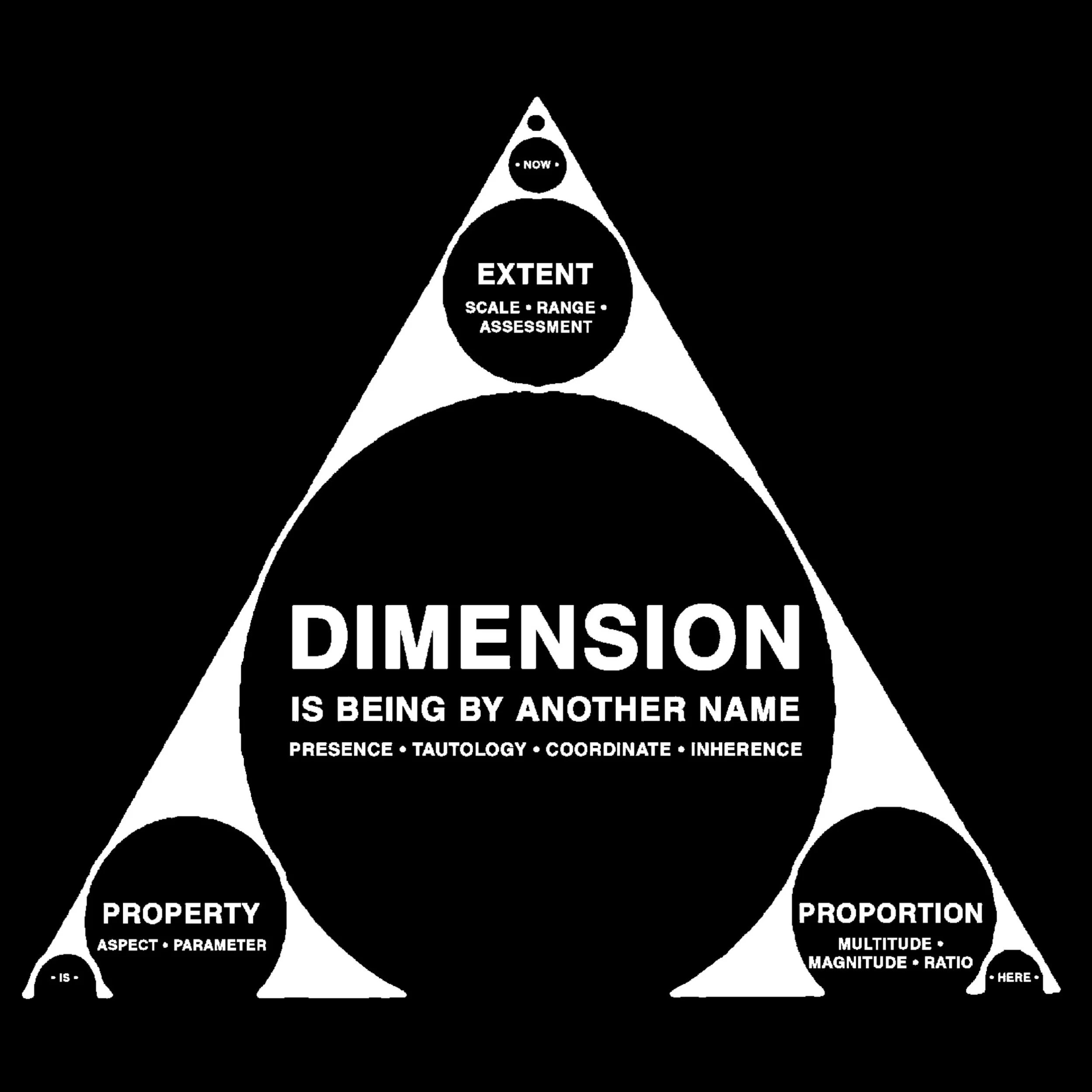
Dimension organizes Thought and Thought's relationship to Substance from a fixed frame of reference. Thought is the pattern of growth in implicit contemplation with Being. Dimension is Thought’s perspective united with extension: Being's unconditional predication that Is, its pure inherence Here as space, and the ever-present Now at harmony with the past, present, and future of time.
Is is the constant scattered through dimensionality–that which commits to Being, that which relates Here to Now, and the term which subsumes another in predication. Predication belongs to Substance and attributes significance to physical presence at a moment in situ. Being is neither object nor creature, not that which merely occupies space nor the thing which simply is, but rather tautology itself–to be is to dwell immediately with itself.
Dimension is not of the Abstract, but of pure abstraction–not of the Concrete as such but what predicates concretion. Being is Dimension by another name. Thought and Dimension are one. Being relates through Thought and with Thought. Thought Dimension makes itself as such in its occupancy Here and Now as space and temporality–in growth and in thinking.
Space as such is dimensional Expansion. Here is space with respect to a knower. Separation is the precept of Here and thus Expansion. Relative in that Here is a subtle consequence of Thought's unique point of view. Space receives Form's gesture in the contradiction of motion and inertia--quietly and passively, space awaits its division. Pure consciousness partitions space according to the standards of Separation:
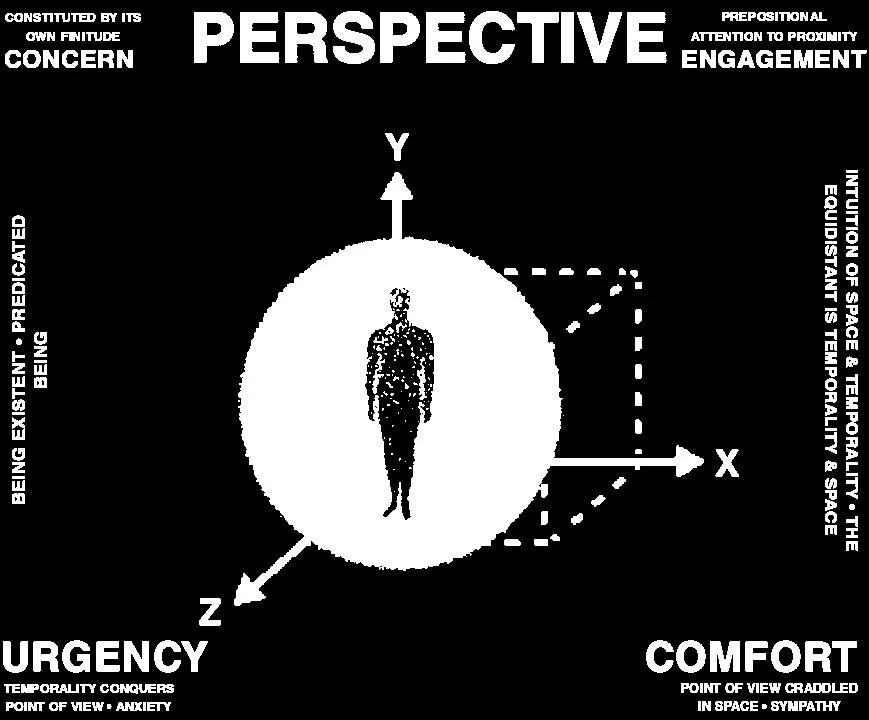
The unique point of view of Thought qua the Body is called Perspective. The acoustic milieu surrounding Perspective is called the Equidistant. Dimension in itself has no point of reference, has no difference within itself–Perspective as such is Dimension in particular. From this defined boundary, the Soul distinguishes between knower from knowing; Here is something distinct from Now; Now is different from Then; There is a place other than Here; self and another are separate.
From Perspective, the Soul sees through sound to perceive the Equidistant from different points of view. In the Equidistant, the Soul listens to pictures and finds Perspective already cradled in space. Space is the area separating the Equidistant from Perspective–space is the factor to which they relate and join one another. Space lies between substances and is the absence of Property. Remove the galaxies and the stars, what else is left save empty space, Perspective, or Nothingness as such.
Perspective dwells Here in its solitary axis–unmediated and undisturbed. Perspective knows itself as dwelling passively: the Soul here and now at the origin, another there at X, another then at Y, and another at Z. Perspective knows itself as dwelling passively. It is only accompanied by its outer sense of Nothingness and extensity. Its engagement Here to the place in which it exists directs the Soul's prepositional attention to proximity and distance–to stare at the furthest point in space is to look backward at a past that one can never return to.
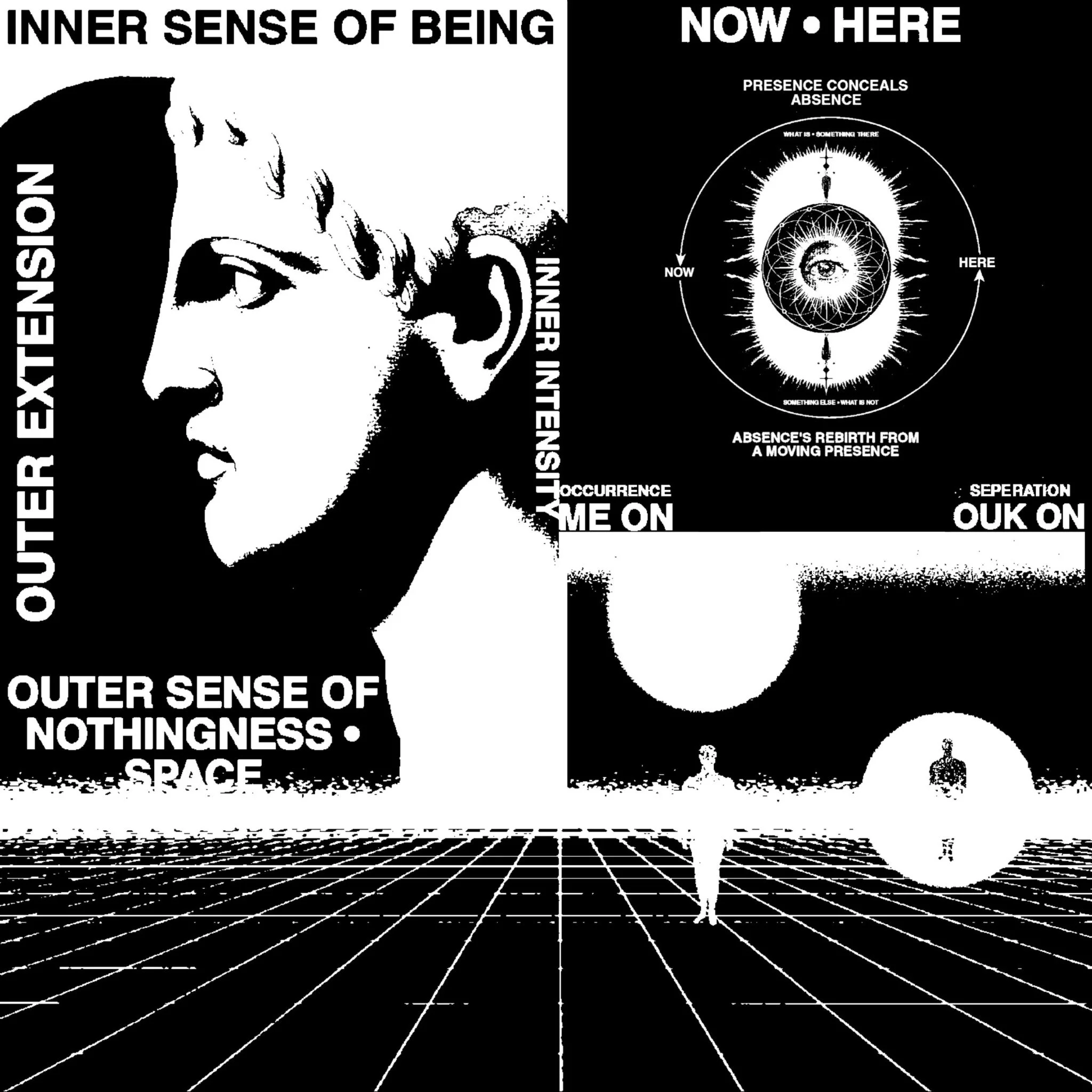
Temporality is Dimension in Contraction. Temporality is Now with respect to the Soul. Occurrence is the precept of Now and thus Contraction. Epistemically, ccurrence is absolute, but, categorically, it is a relative matter. Absolute in that Now is absorbent to all–more immedite to knowing as such, more demanding of attention than Here. With knowing comes a knower. With a knower comes the appearance of Now.
Now comes with the appearance of life. Life is a mixture of the elements–life is Perspective taking space in movement. Perspective relies on a foundation of knowing provided by a finite intuition of Here and Now. Life depends on knowing if it is to survive. Survival and knowing are the immanent concern of Perspective which is constituted by its own finitude.
Life, as such, is the existent Being of consciousness continuous with Mass–Thought which dwells Now and Here with the Body. The Body is thus the habitat of Mind and the Soul. The unity of the Body and the Soul furnishes the activity of life. Thought and the Will collobarate to determine tk.
Temporality only is when it is Thought. Thought is embedded in existence but cannot be disentangled from Now. Thought belongs to Being which dwells exclusively in life. Thought lives instantneously with temporality and is itself pure living. The Body without Thought, Mind, or notion is mere substance waiting to come alive.
Thought inheres in Mind, relates through Mind, and from Perspective. Thought without Mind has no immanent presence in space as there is no point of reference with which it relates--hence, Separation is relative, epistemically. Mind, as such, is the natural habitat of the Soul, hospitable to Spirit, and Thought’s interpenetrebal vessel. Mind’s non-orientable surface folds into its contour and enters existence in four dimensions.
tk
============
MISC
NECESSITY/REASON - [Necessity and Reason are as inseparable as they are in opposition.
===
RANGE
TK [
____
SCALE
[Scale consolidates all the terms/territories of being and knowing into an unending spinal prolongation beginning in the place where movement is constant but goes nowhere. It towers to altitudes and events conceivable only by speculative imagination. Scale is the taxonomy of being and of knowing, thus it qualifies/gives context to Range. To being it represents landscape/topography. For knowing it represents habitat.]
[Scale contains all exponents of knowledge and existence within its spine/column. Through the study of its procession at the sacral bedrock through the transcendental eye, toward the as-yet, unknown infinite, call natures are experienced and assessed.
——
PLANETS
[The planets are the Sun’s wandering companions. Visible to the eyes of the knower from its center of gravity on the flat surface of the Earth, the objects in the sky and on the ground are harmonious. Their choreography interpenetrates with the Body’s movement below the heavens and the Soul residing in the Body. The planets affect terrestrial events but there is no direct influence on consciousness, except symbolic resemblance.
The seasons yield to the Sun as the tides yield to the Moon. The seasons resemble cyclical decay and replenishing growth as the tides resemble passionate excitation. What excites in the Soul and Body resembles the movement across the heavens. The events on the ground are as large as those in the sky—as those in the sky are as miniature as the passions below on the ground. As the Sun and Moon rise and set along the equator]
As such their movement represents time’s preceptial mediation
—-
TITANS (TIME)
—-
MUSES (SPACE)
___
ASSESSMENT
TK [Of all things, everywhere, intimate and remote, Assessment is the critical estimation.
——
SPIRIT/SOUL
[Spirit is the unitary Form of Thought at work in history—pure consciousness independent of a material substrate. The Soul is Thought’s distinguishing Substance at rest in space—empirical consciousness contingent with the Body’s unique perspective. Thought makes itself Spirit
History begins with Man, Memory, and narrative. Narrative memorializes history, bringing past actions into present-day understanding.
[Spirit makes itself Man when Thought records through Man and its narration of crisis. Man makes itself Spirit when it reflects on the archive of Thought written across eons, in the historical endeavors of its kind to be free, and by collective will to Reason. Spirit knows itself as Thought through the community of souls in Man—temporally, as History and Economics, and spatially, as Politics and Law.
======
“I can grasp the multitude in finite quantity,” says Thought. “Its magnitude, however, cannot be understood without common limitation—without establishing the extent.” The Soul finds meaning in the Extent of dimensionality. Dimension in Assessment derives judgment and measure from spatiotemporal categories that determine conditions in which consciousness experiences. The predicate does not limit its subject—the range of possibility is limited insofar as what is not the subject is excluded from the infinite sphere of indefinite terms. Thought’s infinite judgment establishes the genetic conditions of material things and the appropriate precepts of their being.
Dimension communicates with itself—its precepts are the incommensurable language of Being in dialogue with Being. The object of knowing speaks to the subject of knowing—the knower reciprocates with the object observed. Being, living, and knowing are mutually applicable notions. Precepts represent necessary elements of understanding that issue from the nature of consciousness. The taxonomy of predicates define the terms of Range, meaningfully interfaces between individual dimensions at Scale—providing richer definitions of time and space, and are a necessary feature of Assessment—as such requiring a spatiotemporal dimension to describe.
Consciousness cannot produce coherent notions without the precepts of its understanding which make experience possible. A fact cannot be determined without them—experience must conform to their doctrine even as conjecture or belief. At the smallest temporal origins is occurrence and at its totality, dinergy—continuity at the spatial zenith and separation at its lowest point. They are categorical and epistemic but are either absolute or relative as the former or the latter. If the precept can be called categorically absolute then it is an epistemically relative category. If it is epistemically absolute then it must be called categorically relative.
\\
“I can grasp the multitude in finite quantity,” says Thought. “Its magnitude, however, cannot be understood without common limitation—without establishing the extent.” The Soul finds meaning in the Extent of dimensionality. Dimension in Assessment derives judgment and measures from spatiotemporal categories that determine conditions in which consciousness is experienced. The predicate does not limit its subject—the range of possibility is limited insofar as what is not the subject is excluded from the infinite sphere of indefinite terms. Thought’s infinite judgment establishes the genetic conditions of material things and the appropriate precepts of their being.
Dimension communicates with itself—its precepts are the incommensurable language of Being in dialogue with Being. The object of knowing speaks to the subject of knowing—the knower reciprocates with the object observed. The taxonomy of predicates represents necessary elements of understanding that issue from the Soul’s interrogative nature. The precepts of space represent definable points of reference—altitude, longitude, or latitude. A geometric figure is never without the environment upon which it inscribes its coordinates. The temporal precepts are variable instances in which the novel becomes possible at the material level of expression. A narrative cannot be without its central focus—
The Soul does not perceive Occurrence any more than it senses Continuity. The knower perceives an accident that occurs, but not occurrence itself. The knower detects a regularity of space that it appreciates as continuous but not continuity as such. The Soul senses neither Causality nor Separation but comprehends the causal relation between bodies in motion acting upon bodies at rest as causality or the length between objects as separation
